

The New Workforce Ecosystem
It's time to start thinking about Digital Labour

Work feels like it’s breaking. And no, it’s not just because people don’t want to come to the office (that’s not helping). I believe that we are witnessing the traditional model of work is crumbling. The one that is based on industrialist labour practices, that exchanges time for money, and values functional expertise in a narrow type of employment relationship.
And yet, most knowledge work companies limit their human workers to permanent (part or full-time) or contractor / temporary. You can ‘buy’ other forms of human labour through consultancies or service providers, but those too have pre-defined entry points to be ‘hired’. Recruitment and procurement processes have constrained us to a model of sourcing exclusively humans to work in a way that’s no longer fit for purpose for the modern age.
Because humans aren’t the only ones that can provide labour.
AI expands the definition of labour
And now with AI, the fundamental ‘labour-power’ relationship is also changing. Pre-AI, human workers sell their capacity to work and their potential to produce, in exchange for wages. Companies buy individual time and capability, then direct it toward their goals. This is labour as commodity, and it’s the foundation of how we’ve structured employment, compensation, and even our sense of professional worth.
But AI breaks this model open. If a company can now “source” cognitive capacity, problem-solving ability, and even creative output from a machine, what exactly are human workers selling? What’s the unique value proposition of human labour-power when digital labour-power exists?
For the first time, we have a technology that provides us with a complement and potential replacement for humans in knowledge work. This means that AI is a capability, not a ‘tool to use’, but few have recognised it for what it is: AI is a new form of labour that can be deployed and orchestrated alongside human workers. And this fundamental shift in how we think about sourcing and managing labour requires a new model that covers both digital and human aspects of the workforce.
Enter the Workforce Ecosystem, a new way to conceptualise labour in the future of work. It’s built on two foundational assertions:
That the workforce can comprise of both human and digital labour, and something in between (services).
That we need to think of our companies as an ecosystem: a system of interdependent entities that interact, exchange resources, and collectively produce outcomes none could achieve alone.
Understanding the Workforce Ecosystem
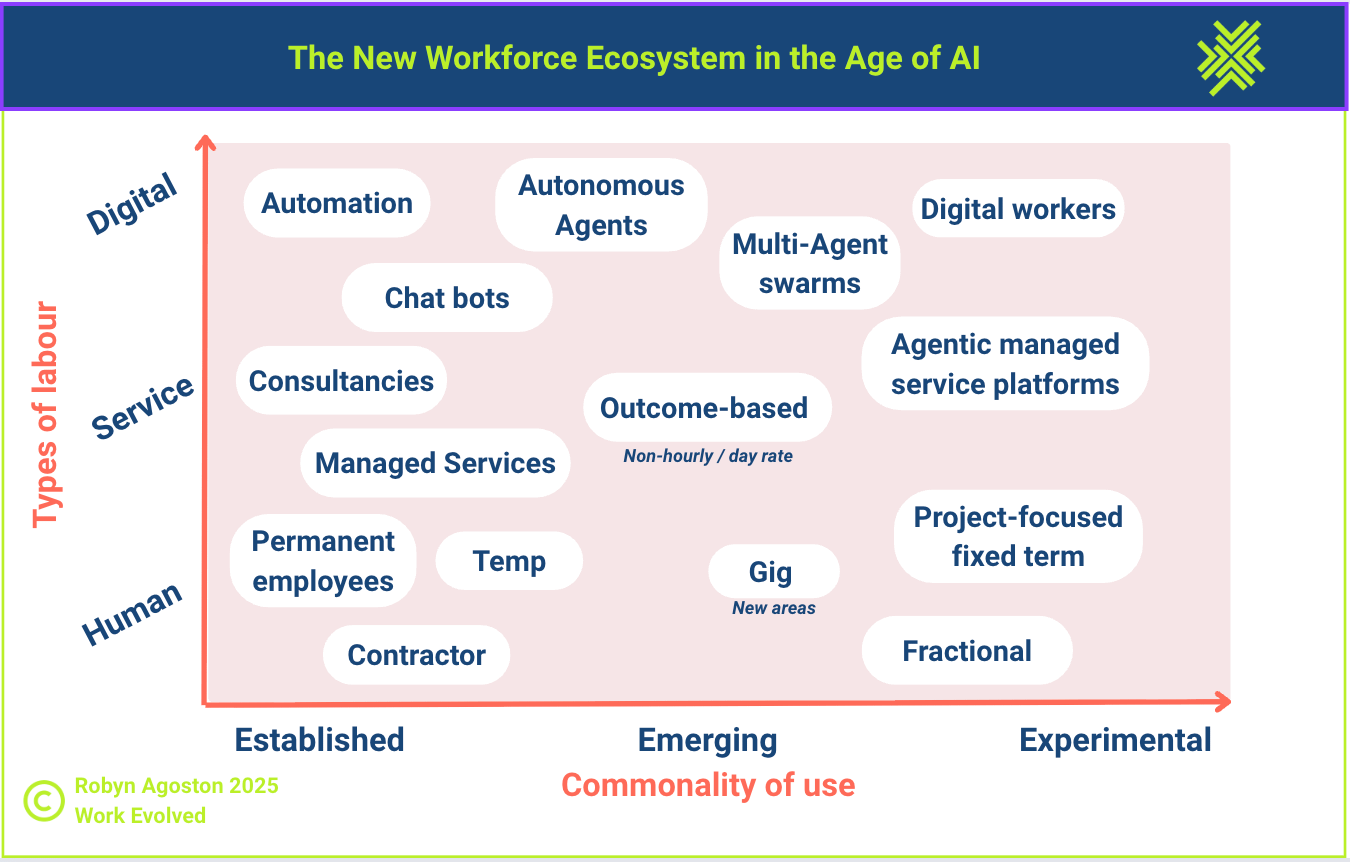
To better understand the Workforce Ecosystem, let’s first define the different layers of labour provided. I have categorised them into three labour categories - human, service and digital - and plotted them along ‘commonality of use’ tracking from established to emerging to experimental.
Human Labour
This is the foundation of your typical workforce today. But the required evolution is moving from rigid, indefinite employment toward flexible, high-expertise liquidity.
Established
Permanent Employees - Human workers with an indefinite employment contract, receiving a salary and benefits in exchange for exclusivity of labour and ongoing availability. It’s the default mode of work for decades, but it’s highly inflexible and is generally perceived to be on the decline.
Contractor - Human talent engaged on an hourly, daily, or monthly rate to provide additional capacity without a specific project deliverable, often used to augment teams indefinitely. Unlike employees, they offer flexibility; unlike project workers, they are often paid for presence (capacity) rather than completion (output).
Temporary - Workers engaged for a short, specific duration to backfill roles or handle surges in volume, typically employed by a staffing agency, and traditionally used for “business as usual” continuity or low-complexity coverage.
Emerging and Experimental
Gig (New Areas) - Also known as ‘Nanoworkers’, which is human labour sourced for specific tasks or micro-projects. This model of work has been enabled by platforms for certain categories of work (i.e. - Uber for taxi rides, Fiver for digital design), but there is a need to shift this model into complex, high-skill domains, where experts monetise their time on a per-task or per-workflow basis.
Project-focused Fixed Term - An individual expert engaged directly via a Statement of Work (SOW) to deliver a specific project within a defined timeframe. This is not a worker for “extra hands”, but they come into an organisation to accomplish a specific outcome and leave when it’s complete.
Fractional - Senior or executive-level experts who split their time across multiple companies, providing high-level leadership (e.g., Fractional CMO, CFO) for a portion of the week. This is common in the start-up world, where small businesses don’t yet need a full-time employee in that role.
Service Labour
A form of labour that’s purchased as an external service from outside the core enterprise. The evolution of this type of labour is from buying “people’s time” to buying “guaranteed outcomes” and / or “AI-driven services.”
Established
Consultancies - Traditional professional services firms hired to solve complex strategic problems or implement changes, relying heavily on human intellectual capital, and typically billed on time-and-materials or fixed fees. Could be augmented by AI Agents, but humans still do the primary work.
Managed Services - Certain parts of the ongoing management of a business function (e.g., IT, HR, Payroll) that are outsourced to an external provider who ensures service continuity, often managed by a Service Level Agreement (SLA), and allows the provider to manage the mix of staff and tech required to deliver. Also could be augmented by RPA and Agents, but the bulk of the work is still done by human labour.
Emerging and Experimental
Outcome-based Services - A contracting model, for Consulting or Managed Services, where compensation is strictly contingent on achieving a pre-defined result, decoupling cost from the “time and effort” spent. This transfers efficiency and delivery risk to the provider, heavily incentivising the provider to leverage AI and automation.
Agentic Managed Service Platforms - Think of a Managed Service provider, but rather than delivering services via humans, it delivers increasingly complex business functions primarily through autonomous AI agents. A few humans will still be needed, but for edge cases and orchestration.
Digital Labour
Work performed mostly or entirely by technology. The evolution here is moving pre-defined scripts to autonomous, anthropomorphic entities.
Established
Automation (RPA) - Script-based software designed to execute repetitive, rule-based digital tasks (e.g., data entry) without deviation. This is the common point of digital labour, which is highly efficient but inflexible.
AI Chatbots - Conversational interfaces using Natural Language Processing (NLP) to facilitate interaction between humans and systems. We are used to them as GPTs like ChatGPT or Gemini, but these models also now power customer communication layers, retrieving info or triggering simple backend tasks based on user prompts.
Emerging and Experimental
Autonomous Agents - Goal-directed AI capable of reasoning, researching, planning, and executing a specific task or series of tasks to achieve an objective without continuous human intervention. They move from following rules to making decisions, where you give an Agent a goal (i.e. - Research this competitor), and they figure out the steps.
Multi-Agent Swarms - A collaborative network of specialised agents working together to complete a significant part of an end-to-end workflow. complex, multi-faceted processes. Often the human-in-the-loop is still involved for direction setting, orchestration and final review, but different agents hand off work to one another independently.
Digital Workers - Anthropomorphic AI entities designed to wholly replace a human job role. They possess a persona, credentials, and the ability to function as a fully fledged team member within existing org structures. Still experimental, but if you’ve had any interaction with Boardy, then you realise it’s not that far away.
Managing your Workforce Ecosystem
When you conceptualise labour in this way, it’s easy to see how much will need to change across an operating model if we are to leverage our Workforce Ecosystem fully
Headcount would not just be humans to manage or a cost to optimise. Rather, the workforce would be a dynamic, interconnected system of capabilities that includes humans (in various engagement models) and digital labour (AI agents, automation, intelligent systems).
You are no longer sourcing very specific skills humans just for particular job descriptions. You would be cultivating and orchestrating productive capability in all its forms across the organisation.
For HR, this means that most of what you do shifts dramatically. The Employee Life Cycle evolves from exclusively permanent human workers to including all forms of labour. How we source, onboard, develop, manage, reward and exit our workforce, if it truly encompasses all digital and human forms described above - will need to be fundamentally reimagined.
For IT / Digital, this means that you now have workforce management responsibilities. The agents you design and deploy, and the workflows they enable, will provide productive labour contribution. And this form of labour has to be treated in some ways like its human counterparts: sourced (or designed), onboarded (given context and data), developed (continuous learning / memory), managed (accuracy, accountability), rewarded (cost of compute / agent) and exit (removed from the system).
For Procurement, you’ve largely been the gatekeepers of all forms of labour except the permanent human kind (and maybe contractors). And the walls you’ve built around your organisations have made it incredibly difficult to enter. If you want to enable the workforce ecosystem, you must do away with the bureaucracy, tedious vendor onboarding and restrictive categories. All forms of labour need to move in and out of the ecosystem seamlessly and without much friction.
What’s clear to me is that no one function is going to solve this problem. Add to this Legal, Compliance, and Finance to the table, as well as the very necessary functional domain experts, and you quickly realise this can only be addressed collectively across an organisation. Yes it’s hard and will take a level of creativity, collaboration and ingenuity rarely seen in corporate… but it really is required if we are going to make the most of both human and AI capabilities in the year ahead.
Wow, great article! It really captures the challenges companies face or will face in the near future.
Are there already companies that you know of that lead the way to incorporate and manage more digital work getting done besides human work?
Great piece Robyn. It really expanded my perspective around the new workforce ecosystem!